What is a Disciple Making Movement (DMM)?
And is it the same as a CPM?
All over the world, we are witnessing an extraordinary shift in frontline missions. In regions where it once felt nearly impossible to share the Gospel, small communities of believers are multiplying at unprecedented speed.
This rapid growth is fueled by a proven kingdom framework: the Disciple Making Movement (DMM). But what makes it distinct—and how does it relate to Church Planting Movements (CPM)?
What is a Disciple Making Movement (DMM)?
At its heart, a DMM is a radically simple, highly reproducible way to share the Gospel and help ordinary people mature in faith. Rather than centralizing ministry into programs, the goal is to multiply believers, discovery groups, and spiritual families rapidly from the grassroots.
A true movement is self-initiating, self-reproducing, and indigenous. It thrives and expands on its own—without requiring massive financial budgets, professionalized clergy, or dedicated physical buildings.
Four Core Hallmarks of a True Movement
1. Focus on Obeying Jesus
Discipleship is not measured by biblical trivia or head knowledge. It is centered entirely on immediate obedience to Scripture and promptly passing on what was learned to family, friends, and neighbors.
2. Keep It Radically Simple
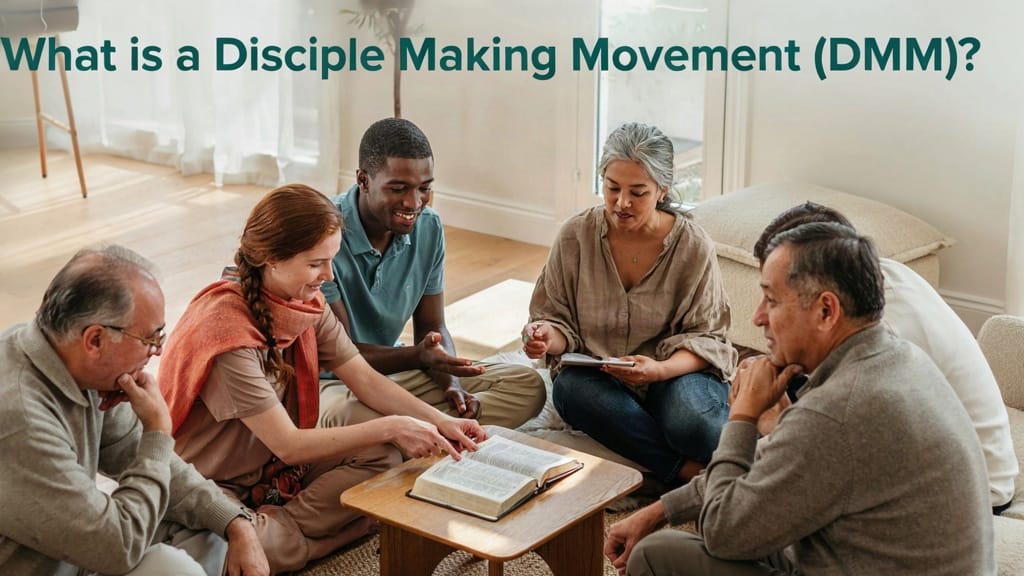
Gatherings occur in natural rhythms—homes, coffee shops, workplaces, and under trees. The format is kept intentionally lightweight so that a new follower of Jesus can confidently lead a group the following week.
3. Discovery Bible Study (DBS)
Rather than listening to an expert lecture or sermon, participants discover truth directly from God's Word together by asking simple, reproducible discovery questions.
4. Fourth-Generation Multiplication
A movement is only classified as a true DMM once it consistently reproduces out to the 4th generation ($A \to B \to C \to D$). This validates that the DNA is self-sustaining beyond the original planter.
The 3 Fundamental DBS Questions
Every Discovery group centers around three simple, repeatable questions that allow the Holy Spirit to teach through the text:
The 4th Generation Standard
Based on 2 Timothy 2:2 — Paul, Timothy, Faithful Men, and Others also.
When the 4th generation reproduces, movement sustainability is achieved without reliance on the original pioneer.
Is a DMM the Same as a CPM?
If you have tracked modern missiology, this may sound very familiar. In the late 1990s and early 2000s, practitioners and mission leaders talked extensively about CPM (Church Planting Movements).
A CPM is defined as a rapid, indigenous multiplication of planting churches that sweeps through a people group or city. Just like a DMM, a CPM relies on ordinary local leadership, simple house churches, and the sovereign work of the Holy Spirit.
So, are they the exact same thing?
In essence, yes. Both terms describe the same organic, explosive spread of multiplying disciples and communities of faith. However, DMM is the evolved terminology that refined the strategic focus of the CPM world.
CPM (Church Planting Movement)
- • Focus was historically placed on the end product: Planting Churches.
- • Risk: Practitioners often defaulted to Western institutional habits (seeking clergy, programs, buildings).
- • Pioneered in the 1990s missiological literature (e.g., David Garrison).
DMM (Disciple Making Movement)
- • Focus is deliberately placed on the catalyst: Making Obedient Disciples.
- • Strength: When you make disciples, healthy indigenous house churches form naturally as the direct fruit.
- • Refined methodology emphasizing Discovery Bible Study (DBS) and 4th-gen reproduction.
Why Did the Name Change?
When the explicit mandate was labeled as "planting a church," church planters and cross-cultural workers unconsciously imported traditional models. They searched for trained pastors, worked out complex liturgies, rented facilities, and orchestrated weekly services.
Inevitably, this institutional weight created a bottleneck. It slowed down reproduction, demanded outside funding, and limited ministry to a few specialized professionals.
“If you plant churches, you don’t always get disciples. But if you make disciples, you always get churches.”
By adopting the terminology of DMM, global leaders refocused on the biblical engine of the Great Commission. Instead of fixating on the destination (the formal church structure), they anchored their energy into the primary process: helping individuals obey Jesus and disciple their own spheres of influence.
When you consistently make genuine, reproducing disciples, healthy, biblical house churches form as the natural, spontaneous byproduct.
Summary: The Book of Acts in Our Time
Whether you call it a CPM, a DMM, or simply an organic kingdom movement, the essential vision is identical. It mirrors the unstoppable momentum seen in the Book of Acts: by stripping away complexity and concentrating on radical obedience to Jesus, the Gospel spreads rapidly from person to person, changing families, neighborhoods, and entire regions.